
Our Technology
A targeted polymeric nanoparticle enabling in vivo cell reprogramming
The delivery constraint in CAR-T
CAR-T efficacy is established. The constraint is industrial.
Today’s therapies rely on individualized, centralized ex vivo manufacturing. Each dose is custom-produced through apheresis (individualized cell extraction), centralized genetic modification, expansion, and reinfusion.
This infrastructure-dependent process creates structural limitations:
Treatment delays: 3–6 week vein-to-vein timelines during which disease may progress
Restricted access: Limited to specialized centers with complex logistics
High manufacturing costs: approximately $120–150K per patient for production alone
Capacity constraints: Fewer than 30% of eligible patients can currently be treated
The limiting factor is no longer clinical validation. It is the scalability of delivery.
Solving cell therapy access requires a new delivery model, not incremental manufacturing optimization.
Targeted in vivo gene delivery
Alaya.bio has engineered a synthetic gene delivery platform designed to enable precise genetic modification of immune cells directly inside the patient.
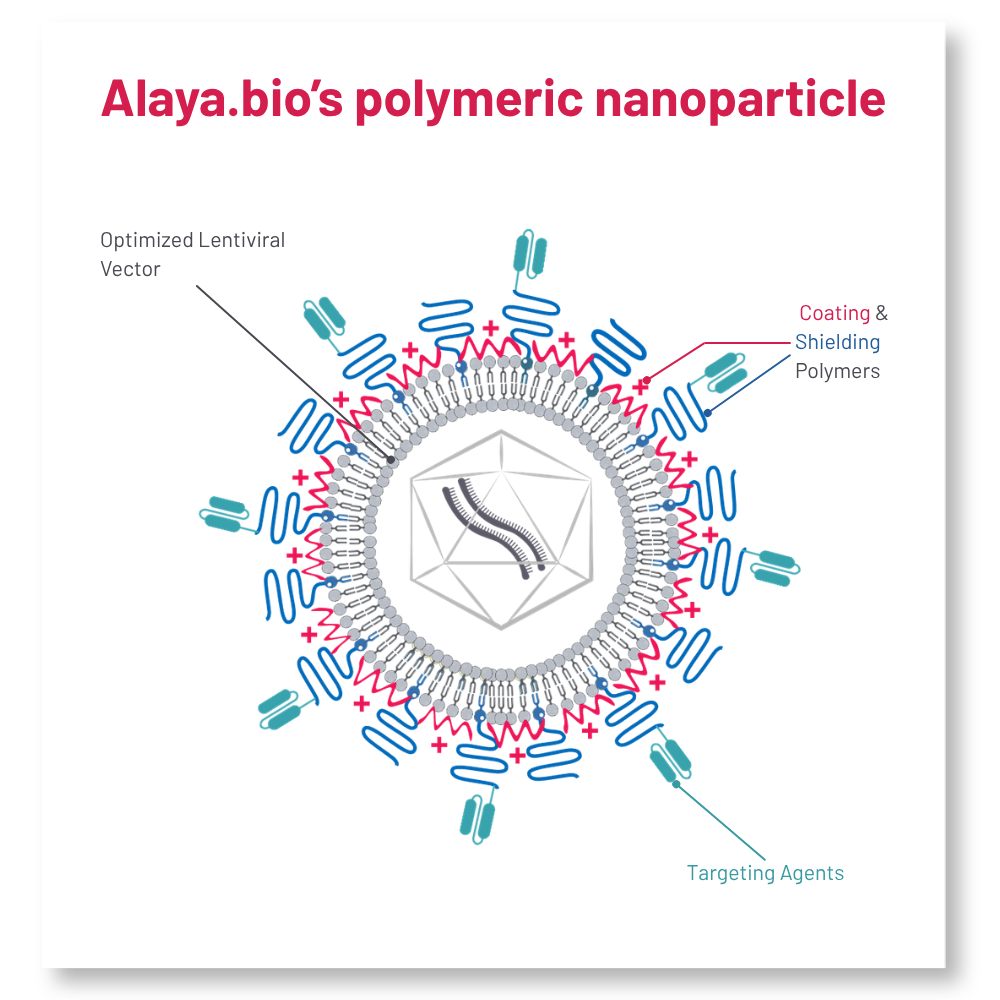
Our technology integrates three core components:
An optimized lentiviral vector carrying the therapeutic genetic payload
Coating and shielding polymers
A grafted targeting agent enabling selective immune cell engagement
This hybrid architecture combines the biological efficiency of viral gene transfer with the precision, stability, and tunability of advanced polymer chemistry. The result is a targeted nanoparticle capable of delivering genetic instructions in vivo, eliminating the need to extract, manipulate, and reinfuse patient cells.
Mechanism of action:
in vivo T-Cell reprogramming
Following systemic administration, the targeting polymeric nanoparticle:
Circulates in the bloodstream protected by the shielding polymer;
Selectively engages defined T-cell populations through humanized targeting agents;
Triggers cellular uptake and pH-driven endosomal escape;
Delivers its lentiviral cargo for either stable genomic integration or transient episomal expression, depending on the indication.
This enables in vivo transduction of circulating T-cells, removing the extract, engineer, and reinfuse cycle required by conventional ex vivo CAR-T.
Why it matters
Scalable Manufacturing
Built on standardized vector production and microfluidic coating processes, the platform supports scalable GMP manufacturing without individualized cell processing.
Drug-Like Administration
Single-infusion systemic delivery enables broader treatment center adoption and geographic expansion.
Redosing Potential
Reduced immunogenicity and controlled biodistribution support iterative dosing strategies.
Modular Architecture
Targeting agents and genetic payloads can be configured for multiple disease indications, enabling expansion beyond oncology.
Alaya.bio is pioneering in vivo CAR-T cell therapy using its proprietary polymeric nanoparticle platform
Our lead program applies this platform to in vivo CAR-T therapy in oncology and autoimmune disease. A single intravenous infusion of our targeting nanoparticle delivers genetic instructions directly to the patient’s circulating T cells, reprogramming them in situ into CAR-T cells inside the body. The construct uses the CD19-1XX CAR with calibrated signaling, which has demonstrated potent efficacy at low cell doses and reduced toxicity in clinical studies.
The same platform architecture extends to other indications. Because the targeting ligand and the therapeutic payload are independently exchangeable, our modular plug-and-play platform can support immune modulation in any other indication that requires precise in vivo cell engineering.
Partnership opportunities
Alaya.bio is advancing toward clinical validation of its in vivo CAR-T program while expanding the broader gene delivery platform.
We are actively engaging strategic partners who are developing genetic payloads, CAR or TCR constructs, or immune-modulating therapies that would benefit from scalable in vivo delivery.